Two additional Schindler R.I.S.E robots have joined the company’s global fleet, as contractors see increasing value in the hardware, which delivers up to 40% time savings while improving safety and working conditions inside elevator shafts.
Schindler is expanding its fleet of construction robots, adding two new units of its Robotic Installation System for Elevators (Schindler R.I.S.E). The expansion comes amid growing global demand for high-tech construction solutions that enhance safety, boost efficiency, and reduce the physical strain of on-site labor. With these additions, the company is now operating seven robots worldwide, supporting projects across multiple markets and delivering time savings of up to 40% during elevator shaft preparation and installation.
Since its launch five years ago, Schindler R.I.S.E has been deployed at 36 job sites worldwide and installed approximately 50,000 anchor bolts — a key structural component in elevator shafts. Projects have spanned Austria, Poland, India, the UK, Brazil, China, Singapore and beyond, as interest in robotic elevator installation continues to grow.
“We are seeing growing demand worldwide as construction projects face tighter deadlines and increasingly prioritize safer, improved working conditions onsite,” said Faruk Osmanbasic, lead advanced installation technologies at Schindler. “Elevator installation is carried out in confined spaces, where workers may spend hours exposed to noise and dust from drilling. Contractors are recognizing the wide range of benefits these robots bring.”
Replacing strain with efficiency
Elevators are among the most essential — and least visible — technologies in modern cities. Before passengers move between floors in a finished cabin, however, an intensive process unfolds inside the concrete shaft of a building.
A critical part of every elevator system is the guide rails — long, precisely aligned steel tracks that ensure smooth vertical travel. These rails are secured to the shaft walls using brackets, each fixed with multiple anchor bolts.
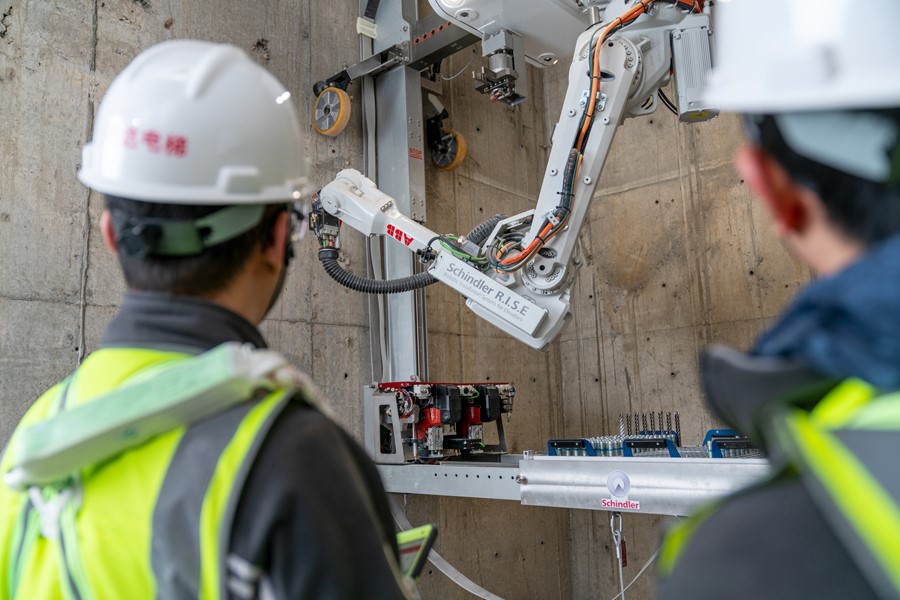
Schindler R.I.S.E prepares the shaft walls by measuring positions, drilling holes and installing anchor bolts for the guide rails and elevator doors. A high-rise elevator shaft could have around 1,000 anchor bolts. In supertall buildings, or in seismic zones, that figure can climb quickly. An elevator group in one recent project required more than 4,900 anchor bolts on a single site.
Traditionally, installing those bolts has meant weeks of heavy drilling for on-site workers, with the associated vibration, dust exposure and physically demands, performed meter by meter as technicians climb working platforms inside confined shafts.
Schindler R.I.S.E was developed to transform this operation, increasing safety, improving efficiency and ensuring consistent, high-quality installation. Rather than replacing human expertise, the system was designed to take over the loud, repetitive and physically strenuous tasks — allowing skilled technicians to focus solely on the outcomes of the work: precision alignment, guide rail installation and overall ride quality.
Autonomous operation
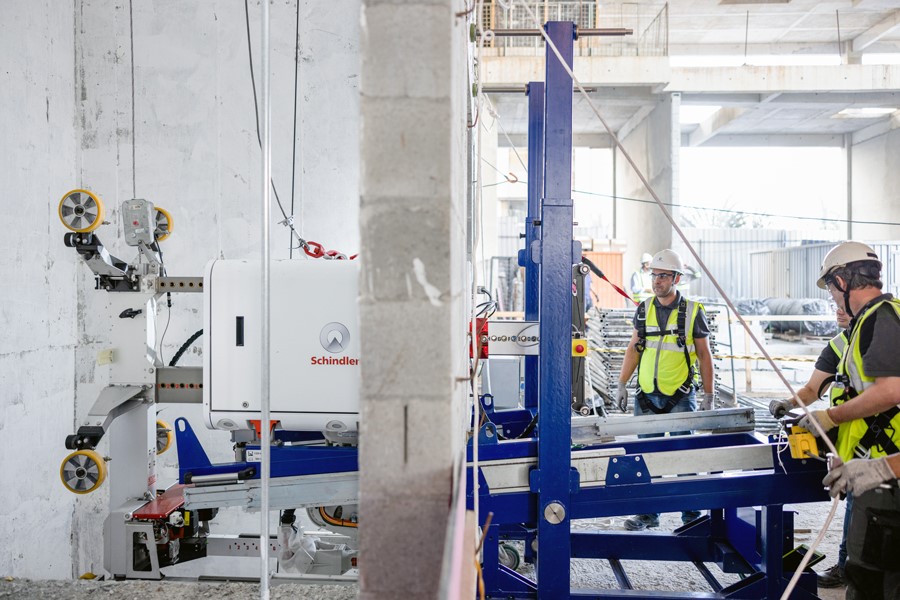
Transported in two wooden boxes, the robot and all necessary accessories arrive on site ready for deployment. The unit is mounted on a transportation trolley and positioned at a shaft opening. Suspended by its own winch system and secured by integrated safety mechanisms, the robot can move up and down into the shaft, where it operates autonomously according to a pre-uploaded digital work plan.
Once in place, the system braces itself securely within the shaft and begins scanning the concrete surface to avoid drilling into steel reinforcement. It drills holes with high precision and installs anchor bolts at pre-programmed heights and positions. Every step follows a detailed digital layout that has been prepared in advance for the specific building. Operators monitor the entire process via a tablet interface, where they can follow progress in real time through live camera feeds and performance data.
Expanding Schindler R.I.S.E hubs
As demand increases, the elevator company is strengthening the global infrastructure that supports Schindler R.I.S.E deployment. When not at construction sites, the robots are maintained at strategically located hubs, positioned in regions where demand is strongest, allowing them to be dispatched quickly and efficiently.
Schindler currently operates hubs in Switzerland, Hong Kong and Australia, where the robots return for servicing between projects. Additional hubs are under evaluation in high-growth markets to ensure shorter transportation routes and faster deployment.
The future of construction
Construction has historically lagged other industries in automation. But as cities grow taller, labor shortages intensify and safety standards become more stringent, robotics is increasingly becoming a practical driver of productivity.
The unique Schindler R.I.S.E solution reflects the company’s commitment to enhancing the quality of urban living, investing in smart ways to bring innovation paired with employee safety and well-being to the construction industry.
“The feedback that we get from customers across the globe is that Schindler R.I.S.E is a very robust solution that offers high precision and delivers excellent results,” Osmanbasic said. “What we are seeing is only the beginning.”
To learn more about Schindler R.I.S.E, click here.