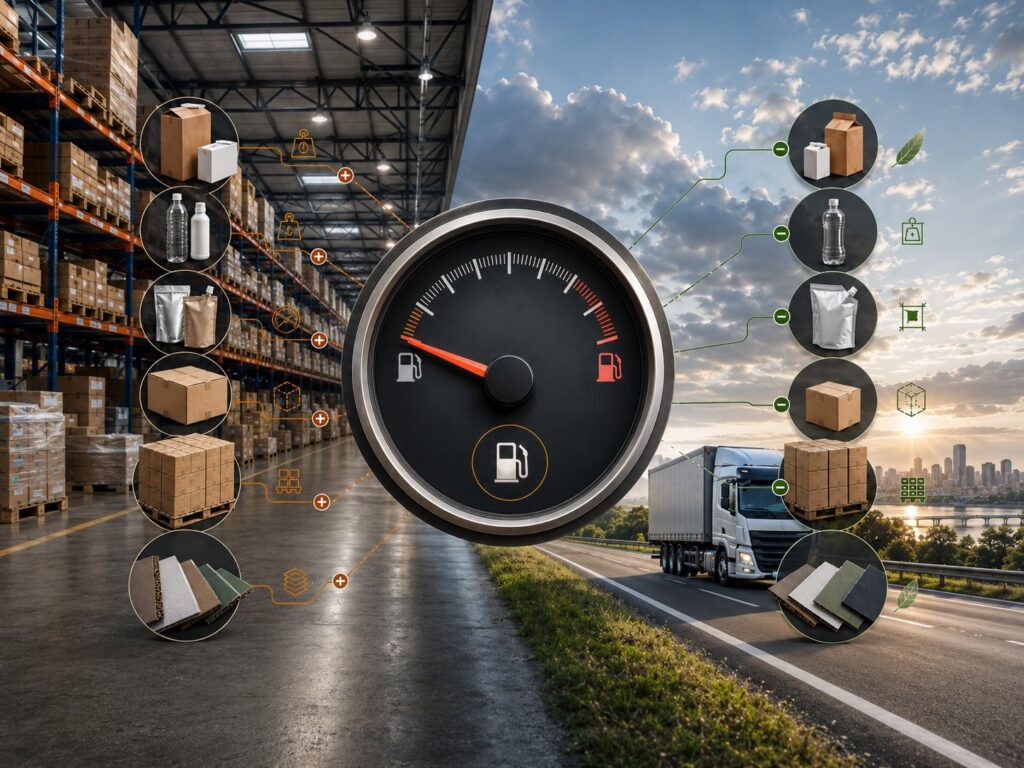
When fuel prices rise, most businesses look first at transport contracts, route planning and supplier costs. Very few look closely enough at packaging.
They should.
Every unnecessary gram on a pack becomes weight in the supply chain. Every oversized carton affects pallet density. Every inefficient format takes up space that still has to be moved, loaded, stored and delivered. In a market where more than 80% of South Africa’s goods move by road, these are not small decisions. They become recurring costs.
South Africa’s recent fuel increases have made distribution costs harder for businesses to absorb. From 1 April 2026, diesel increased by R7.37 to R7.51 per litre, even after temporary fuel-levy relief was applied. Further increases followed in May, adding more pressure to companies that rely on road freight to move products across the country. For businesses with tight margins, this pressure moves quickly from the pump into the cost of getting products to shelf.
Packaging sits directly inside that equation.
Packaging is a logistics variable
Material choice, pack weight, structural format and pallet efficiency are often treated as technical decisions. In practice, they are commercial ones too. A heavier substrate than the product needs adds cost across every unit, every route, every month. A carton that does not stack efficiently reduces the number of products per pallet. Secondary packaging that exists out of habit occupies space that fuel still has to carry.
These are not always dramatic inefficiencies. That is why they are easy to miss. But when they repeat across thousands of units, across multiple routes and trading cycles, they become material. “Packaging briefings rarely include a line item for transport efficiency, but they probably should,” says Vanessa Bosman, Managing Director at Just Design. “The brands managing fuel pressure most effectively right now are likely the ones whose packaging was already designed around how their products move through the real world, not only how they look on shelf.”
Where the opportunity sits
The opportunity doesn’t always need a full redesign. In many cases, value can be unlocked through a focused structural review: reducing unnecessary material, improving stackability, rationalising secondary packaging, or rethinking how products fit into cases, pallets and retail environments.
That is where packaging moves beyond appearance. It becomes part of the operating model of the brand. Good packaging needs to attract attention, build recognition and create desire. But it also needs to work hard beyond the shelf. It needs to protect the product, support the supply chain, reduce avoidable cost and give the business room to respond when external pressures change.
A different kind of partnership
Packaging has often been managed in separate parts. A design brief goes to the agency. A production conversation happens elsewhere. Logistics works with what arrives. Commercial teams deal with the cost implications after the fact. That model is becoming harder to justify.
When fuel, materials, retail requirements and supply chains are all under pressure, packaging needs to be considered earlier and more intelligently. The right conversation is not only about what the pack should look like. It is about what the pack needs to do, where it needs to travel and what it needs to protect commercially.
“The brands getting the most value from their packaging partners are not only briefing them on new flavours or simple updates,” says Bosman. “They are having ongoing conversations about substrates, format efficiency, SKU complexity and the pressures coming into the system. That kind of relationship creates better design decisions and better business decisions.”
Fuel prices will continue to move. Material costs will continue to shift. Supply chains will continue to face pressures that brands cannot fully control. What brands can control is how intelligently their packaging is designed to move through that complexity. That is not only a logistics conversation. It is a design conversation.
And for brands looking to protect margin, reduce waste and build resilience, it is one worth having now.