
Route: Gauteng → N1 North → Polokwane → R71 East → Moria / Mookgophi
Timing — when to travel
Avoid the N1 North on Good Friday and Easter Sunday entirely if you are not a pilgrim. The ZCC pilgrimage moves hundreds of thousands of people to Moria over Easter. Inbound traffic peaks on Thursday evening, Good Friday dawn and outbound surges on Easter Sunday afternoon. Non-pilgrims travelling north towards Polokwane or Limpopo should depart on Wednesday or Saturday morning to avoid the worst congestion windows.
Hotspot zones on this corridor
The N1 between Bela-Bela and Polokwane, and the R71 turnoff east of Polokwane, are the highest-risk stretches. High pedestrian volumes spill onto the N1 as pilgrims on foot approach Moria — especially in the final 30–50km.
Pedestrian crossing risk
It is extreme at night and early morning. Reduce speed significantly through this corridor. The R71 east of Polokwane becomes a slow-moving convoy of buses, taxis and minivans, rear-end incidents are common due to sudden stops.
Behaviours to watch
Overloaded taxis, buses stopping without warning, and pedestrians on the carriageway are the top hazards.
Sudden stops by buses and taxis dropping pilgrims generate near-collision chains identical to the N3 data pattern.
Pedestrian presence on the N1 is atypical for a national route but is entirely expected here.
Fatigue among long-haul bus and taxi drivers completing overnight journeys is a significant but undercounted risk factor. Maintain a minimum 4-second following gap on this corridor.
Alternative routing
If travelling to Limpopo, consider the N11 via Mokopane as a bypass around the R71 congestion. N11 via Mokopane is a viable detour for travellers heading to Tzaneen, Hoedspruit or the Lowveld. It avoids the R71 pilgrimage corridor entirely. Add approximately 25–35 minutes but gain predictable travel time. Confirm road conditions with SANRAL before departure — check www.nra.co.za for Easter Weekend advisories.
Get to your Easter Destination Safe
Best time to travel
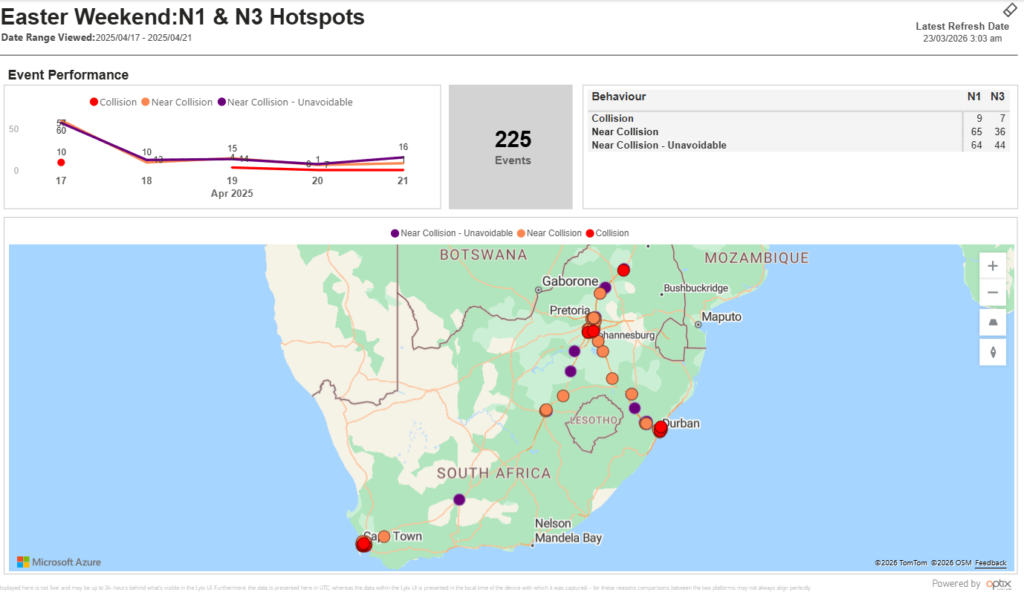
Avoid Good Friday — it is by far the most dangerous day. Data shows 117 near-collision and collision events on 17 April alone, more than double any other day. If you must travel, depart very early (before 5 am) or wait until Saturday morning when volumes drop sharply. The safest window is 20–21 April (Easter Monday).
Routes to watch
The N1 (Johannesburg–Cape Town) records more incidents than the N3
N1 — higher risk
N3 — significant risk
The Johannesburg–Pretoria corridor and the stretch approaching Durban are the densest hotspots. Both routes see collision clusters near urban on-ramps. Allow extra following distance and use rest stops on the N1 between Johannesburg and Bloemfontein.
Top behaviours causing crashes
Near collisions dominate — and they are a leading indicator for actual crashes. Over 47% of all events were classified as near-collision or unavoidable — meaning drivers were seconds away from impact. Following too closely, late braking, and lane drift are the primary triggers. Keep a 3-second gap at all times.
Practical safety tips
Small habits prevent the majority of Easter Weekend incidents
- Plan rest stops every 2 hrs
- No night driving on N1/N3
- Check tyres before departure
- Zero alcohol — zero exceptions
Fatigue and impaired reaction time are the silent multipliers behind near-collision events. With 108 “unavoidable” near-miss events recorded, conditions on these routes demand full alertness at every moment.