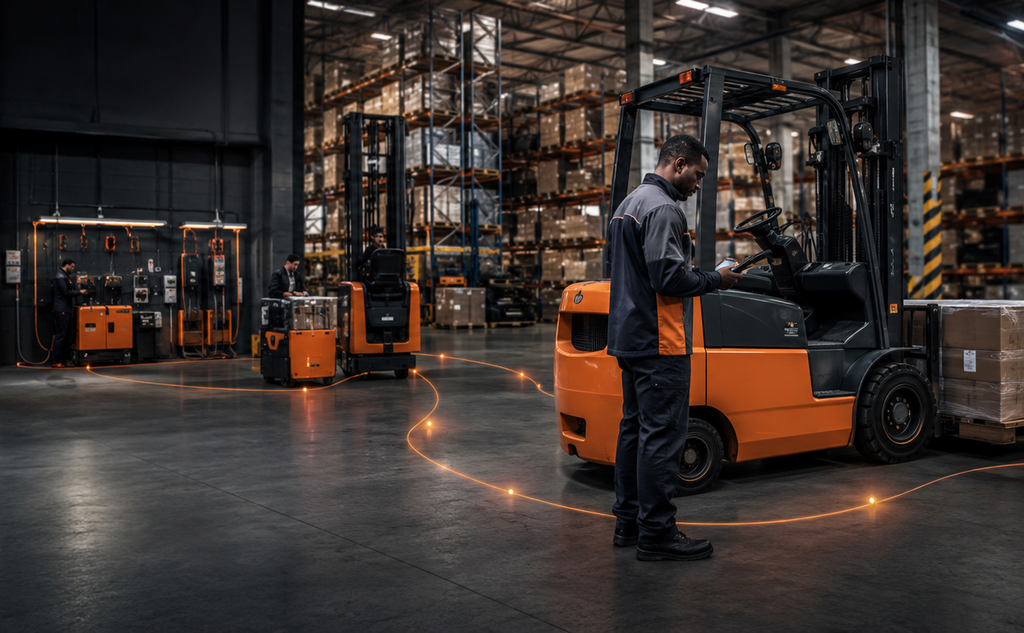
The future of supply chain is connected.
That message came through strongly at the recent 3rd annual Chain Connect Conference, where conversations around operational excellence, visibility, digital transformation and artificial intelligence repeatedly returned to one fundamental requirement: better decisions depend on better-connected information.
Most supply-chain operations are not short of data.
Warehouses generate it. Transport systems generate it. ERP and WMS platforms generate it. Vehicles, equipment, service providers and increasingly connected devices generate it. The challenge is that much of this information still exists in separate systems, departments and operational silos.
And one area that is too often disconnected from the wider supply-chain picture is materials handling equipment.
Materials Handling is not a side operation
Forklifts, reach trucks, pallet trucks, order pickers, batteries and other materials-handling assets are sometimes viewed primarily as equipment that needs to be purchased, rented, serviced and maintained. Operationally, however, they are much more significant. They are the physical link between inventory and movement. When materials-handling equipment is unavailable, the impact can move quickly through the supply chain.
- A forklift breakdown can delay loading.
- A battery problem can affect equipment availability.
- An overdue service can create an operational or compliance risk.
- Slow breakdown attendance can extend downtime.
- A recurring repair can indicate a much larger utilisation, application or equipment problem.
- Individually, these may appear to be fleet-management issues.
- Collectively, they are supply-chain performance issues.
That distinction becomes increasingly important as organisations pursue greater visibility across their operations.
We have plenty of data. The problem is connecting it.
Most materials-handling operations already generate substantial amounts of information.
There are service records, breakdown reports, technician job cards, repair quotations, maintenance schedules, hour-meter readings, load tests, battery records, contract information and equipment utilisation data. The problem is rarely that the information does not exist. The problem is where it exists.
Some may sit with the equipment supplier. Some with the service department. Some in spreadsheets. Some in emails. Some on paper job cards. Some in WhatsApp conversations. And some within systems that do not communicate with the wider operation. Each source may tell part of the story. Very few show the whole picture.
More data does not automatically create better visibility. Connected data does.
Consider a forklift that repeatedly breaks down. Looking at the repair history alone may tell you what components were replaced and how much the repairs cost.
- Connect that information with hour-meter readings and you begin to understand utilisation.
- Connect it with technician attendance and job-card information and you can assess response and repair times.
- Connect it with service history and you can determine whether maintenance is taking place when it should.
- Connect it with battery information and another potential performance factor becomes visible.
- Connect it with contract and cost data and you can start assessing whether the asset remains economically viable.
Then put all of that into the context of the warehouse or distribution operation it supports. Suddenly, a breakdown is no longer just a breakdown. It becomes part of a much richer operational picture. That is the difference between recording events and creating intelligence.
Visibility changes the conversation
Connected operational information also changes the questions organisations can ask.
Instead of:
“How many breakdowns did we have?”
The question becomes:
“Why are these assets breaking down repeatedly?”
Instead of:
“Was the machine serviced?”
It becomes:
“Are servicing patterns affecting reliability and uptime?”
Instead of:
“What did we spend on repairs?”
It becomes:
“Which assets are costing more to operate than the value they are delivering?”
Instead of simply asking whether suppliers are attending breakdowns, businesses can examine response times, repair times, repeat failures and SLA performance. This moves fleet management away from administration and towards operational intelligence. And that intelligence can influence decisions far beyond the fleet itself.
The AI conversation starts with connected data
Artificial intelligence was understandably a major part of the conversation around the future of supply chain. Its potential is significant. AI can identify patterns across enormous datasets, highlight anomalies, predict risks and help organisations make decisions faster.
In materials handling, that could eventually mean identifying equipment likely to fail, recognising abnormal repair patterns, predicting maintenance requirements, comparing asset performance across sites or identifying opportunities to optimise fleet composition.
But there is an important reality behind the AI conversation. AI cannot create meaningful operational intelligence from information it cannot see or connect. If service history sits in one system, fleet information in another, battery records somewhere else and critical operational events remain buried in spreadsheets, emails or WhatsApp messages, the intelligence available from that data will always be limited.
Before businesses can fully benefit from artificial intelligence, many first need to solve a more fundamental challenge: connecting the operational data they already have.
Materials Handling needs to become part of the connected supply chain
Supply chains are becoming increasingly integrated. Warehousing, transportation, inventory, customer demand and delivery performance are being viewed as interconnected parts of the same operational ecosystem. Materials handling should be no different.
The fleet operating inside a warehouse, distribution centre, manufacturing facility, cold store, retail environment or port directly influences the performance of that operation. Its availability matters. Its utilisation matters. Its maintenance matters. Its compliance matters. Its cost matters. And increasingly, its data matters.
The next evolution of materials-handling management will therefore not simply be about better forklifts, more telemetry or another standalone fleet system. It will be about making materials-handling information visible and useful within the broader supply-chain environment.
From managing equipment to understanding operations
This is also changing what fleet-management technology needs to achieve. The objective should no longer be simply to create another place to store information. It should be to connect the operational relationships surrounding every asset.
At Forklift Management Consulting (FMC), this principle has become central to how we view the future of fleet management. An asset does not exist independently of the technician who repairs it, the battery that powers it, the service schedule that maintains it, the contract governing it, the supplier supporting it or the operation depending on it. Those relationships need to be visible.
Connecting them provides organisations with a clearer operational picture, not simply another dataset. And as supply-chain technology continues to evolve, that distinction will become increasingly important.
The future is not more data. It is connected data.
The materials-handling industry has spent decades improving equipment. Machines have become safer, more efficient and increasingly intelligent. The next opportunity lies in improving the intelligence surrounding those machines. That means connecting assets with maintenance.
- Maintenance with technicians.
- Technicians with service performance.
- Assets with batteries.
- Repairs with costs.
- Contracts with supplier performance.
- Fleet performance with operational performance.
- And ultimately, materials handling with the wider supply chain.
Because the future of supply chain will not be defined by which organisation collects the most data. It will be defined by which organisation can connect that data, understand what it means and act on it fastest. For materials handling, that future has already started.