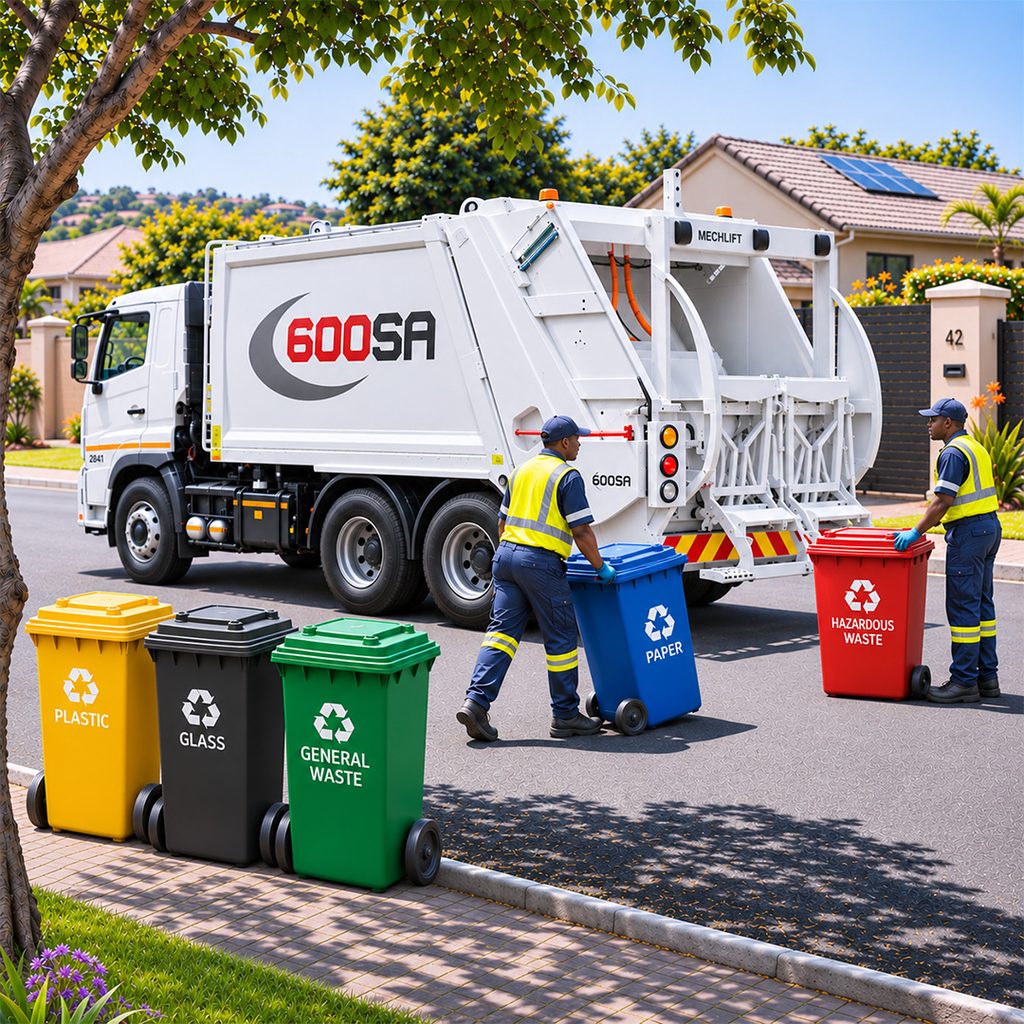
With landfill capacity under increasing pressure, recycling rates remaining low and municipalities facing mounting operational challenges, the need to rethink how we collect, manage and process waste has never been more urgent.
Sonia Pretorius, National Sales Manager for 600SA, a division of CFAO Equipment, says the scale of the challenge is significant. “Industry figures cited at recent waste management forums note that only about 11% of waste is currently recycled, while approximately 89% ends up in landfill. Organic waste diversion is even lower, at an estimated 5%.
“With municipalities under increasing pressure to reduce the volume of waste sent to landfill rather than simply expand existing sites, the transition towards more sustainable waste management practices is no longer optional,” she adds.
The circular economy, waste separation at source and improved recycling infrastructure are becoming central to the industry’s future.
But, notes Pretorius, achieving meaningful change requires more than new policies, it demands practical solutions, smarter infrastructure and collaboration across the entire waste value chain.
At 600SA, this changing landscape has prompted a closer look at how waste collection equipment can contribute to the bigger picture. While refuse compactors remain essential to municipal and commercial waste collection, the future calls for equipment that supports resource recovery as well as efficient waste disposal.
One practical step is the introduction of split-bin compactors. By providing separate compartments within a single unit, these machines offer the opportunity to keep selected waste streams apart during collection, reducing the risk of recyclable materials becoming contaminated by general waste. Depending on local collection and processing requirements, compartments could accommodate recyclables, organic waste or garden waste.
This approach could also help municipalities and contractors streamline collection operations, potentially reducing the need for separate collection vehicles and unnecessary trips. When supported by conveniently located sorting and recycling facilities, it offers an opportunity to improve efficiencies throughout the waste management chain.
Pretorius says technology is equally important. “Through the integration of Radio Frequency Identification (RFID) and onboard weighing systems, waste collection vehicles can capture valuable data, including collection volumes, bin lifts and waste distribution.
“Combined with telematics, this information can help municipalities better understand their waste generation patterns, optimise collection routes, assess fleet requirements and make more informed infrastructure decisions,” she notes.
Ultimately, South Africa needs to move beyond simply collecting and disposing of waste. Recovering valuable resources, supporting small and medium-sized recycling enterprises (SMEs), enhancing conditions for waste pickers and strengthening the circular economy must all form part of the solution.
At 600SA, the focus is on evolving alongside the industry: offering practical solutions today while actively exploring what tomorrow’s waste management landscape will demand.
“The challenge is substantial, but so is the opportunity. South Africa cannot afford to keep burying resources that could be recovered, reused and given new value. The need to rethink waste management has never been more urgent,” concludes Pretorius.