
Logistics costs are rising faster than economic output, while improving rail performance is beginning to reduce the economic cost of freight system underperformance, report finds
The cost of moving goods through South Africa is projected to reach a record R1.16 trillion in 2026, equivalent to 14.6% of GDP, highlighting the growing economic importance of making the country’s freight system more efficient, reliable and competitive.
These findings are contained in the new State of Logistics™ 2026 report for South Africa, produced by consultative research firm GAIN Group and sponsored by Absa Business Banking and the Western Cape Government Mobility Department. The report provides an evidence-based assessment of South Africa’s national logistics costs and the factors driving them.
South Africa’s logistics bill is estimated to have crossed the R1 trillion mark for the first time in 2025, before increasing by a further R147 billion in 2026. At 14.6% of GDP, the projected logistics cost burden is the highest recorded over the report’s quantified 2003 to 2026 period.
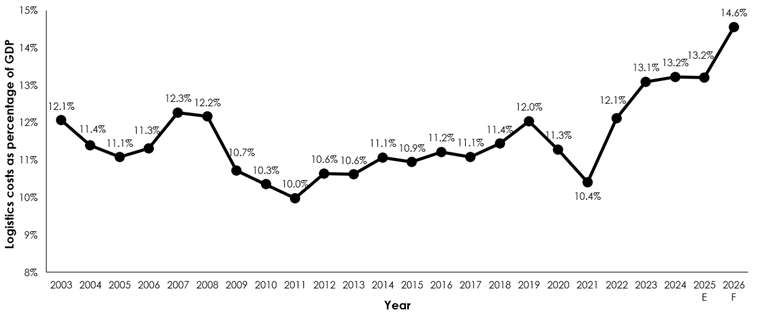
Figure 3: South Africa’s logistics costs as a percentage of GDP, 2003–2026.
Source: Logistics Cost Model for South Africa (2003-2024; 2025 estimate and 2026 forecast) for logistics cost; Statistics South Africa’s Statistical Release P0441 (2003-2025) and GAIN Group 2026 forecast for gross domestic product.
The importance of logistics extends across the economy. Almost everything that is mined, manufactured, grown, imported, exported or consumed depends on the logistics system to move it. The cost and efficiency of this movement ultimately influence the competitiveness of South African businesses, the prices consumers pay and the country’s ability to compete in international markets.
“The trillion-rand figure brings the scale of South Africa’s logistics challenge into sharp focus,” says Professor Zane Simpson, Director at GAIN Group. “The key issue, however, is not simply how much we spend on logistics, because South Africa is inherently a transport-intensive economy. It is how much of that cost can be avoided through better modal choices, optimising utilisation of available logistics capacity, more reliable infrastructure and more efficient operations.”
Transport accounts for almost six of every ten Rand spent on logistics and remains the biggest contributor, accounting for 59% of total logistics expenditure, or approximately R683 billion in 2026. Transport costs alone are projected to rise by R117 billion between 2025 and 2026, accounting for almost 80% of the increase in the national logistics bill.
Inventory carrying has become the second-largest cost, rising from R182.5 billion in 2025 to an estimated R191.4 billion in 2026. Warehousing (R151.7 billion) and management and administration (R130.3 billion) make up the balance in 2026.
The report also provides encouraging evidence that improvements in freight rail are beginning to reduce the economic consequences of its underperformance. These costs fell from an estimated R410.7 billion in 2022 to R180.8 billion in 2025, although the remaining burden is still equivalent to R495 million a day.
Rail freight volumes have also recovered from approximately 149.5 million tonnes in 2022/23 to 167.9 million tonnes in 2025/26, but the report cautions that higher rail volumes will only translate into economic gains if they deliver reliable services, competitive costs and a more appropriate allocation of freight between road and rail.
| KEY FIGURES | |
| R1.16 trillion | National logistics costs projected for 2026, up R147 billion (14.6%) on 2025 |
| 14.6% of GDP | The highest logistics cost burden in the 2003–2026 series |
| 59% | Share of the bill spent on transport, which drives almost 80% of the 2026 increase |
| +112% | Forecast rise in road freight rates between 2014 and 2026, against +60% for rail |
| R495 million a day | Economic cost of freight rail underperformance in 2025 (R180.8 billion a year) |
“For businesses, logistics is not an abstract infrastructure issue. It directly affects input costs, working capital and reliability,” says Justin Schmidt, Sector Executive for Transport and Logistics at Absa Business Banking. “The encouraging signs of rail recovery show what is possible. Building on this momentum can support a more efficient freight system, helping to lower logistics costs and strengthen South Africa’s competitiveness.”
The pressure will only grow. Freight demand amounted to 790.1 million tonnes in 2024 and is forecast to reach just over 1 billion tonnes by 2055.
The report sets out three ways to bring avoidable costs down: move freight on the mode best suited to it, make better use of available transport capacity, and improve operating efficiency. Had these improvements been in place from 2022, logistics costs could have been around 12.7% of GDP in 2026 instead of 14.6%, a saving of about R149.3 billion, and close to R667.5 billion over the five years from 2022.
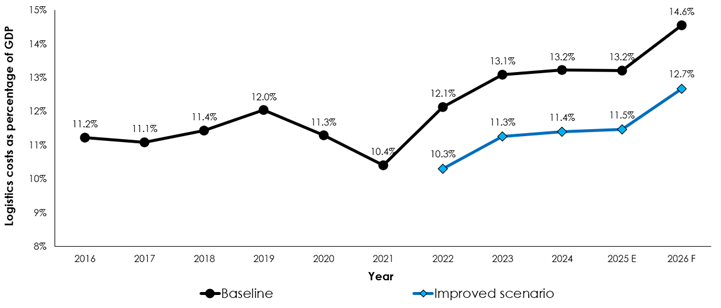
Figure 20: National logistics costs as a percentage of GDP: baseline and improved scenario.
Source: Logistics Cost Model for South Africa (2022-2024; 2025 estimate and 2026 forecast).
The report notes that government shapes the conditions that make these improvements possible, through the planning of intermodal terminals, port access and road connections, land-use decisions that determine where logistics activity is located, and well-maintained roads.
Corrine Gallant, Deputy Director: Freight at the Western Cape Government’s Mobility Department said: “Efficient freight movement is fundamental to economic growth and export competitiveness. Addressing the logistics challenge requires sustained collaboration between government and industry, backed by credible data that enables us to target investment and interventions where they can have the greatest impact.”