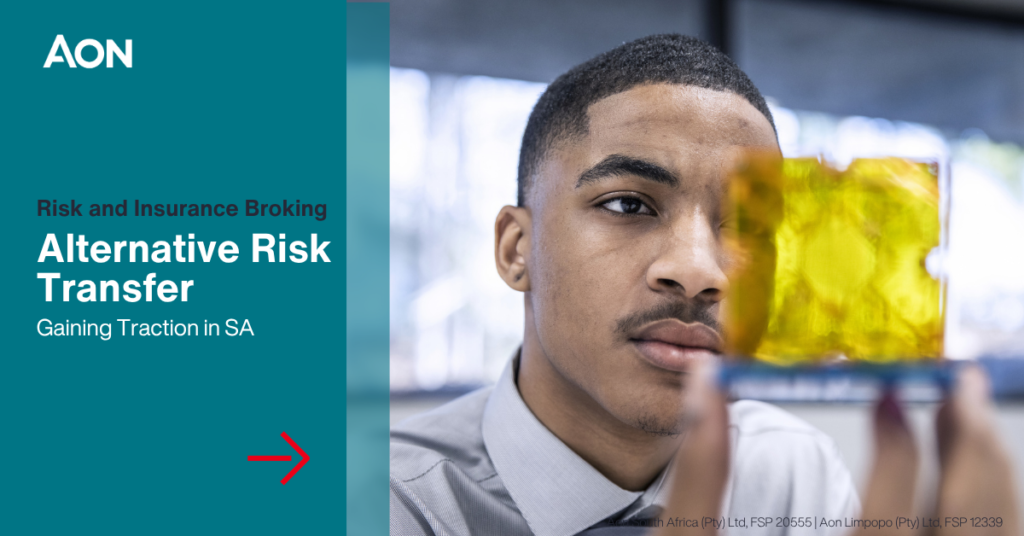
Alternative Risk Transfer Gains Traction in SA
Rethinking Risk in a Volatile World. In an environment defined by economic pressure, constrained insurance capacity and rising volatility, South African businesses are being forced to rethink how they approach risk.
According to Kavil Singh, Product Development Manager at Aon South Africa, traditional insurance alone is no longer sufficient. Alternative risk transfer (ART) solutions are increasingly being used to address the limitations of conventional insurance markets, offering businesses more flexibility, control and long-term cost stability. For companies navigating today’s uncertain landscape, ART is shifting from a niche strategy to a core component of modern risk management.
“Businesses are operating in a far more complex risk environment than before. ART solutions provide a way to bridge gaps in traditional cover while giving organisations greater control over how risk is financed over time,” Singh explains.
Alternative Risk Transfer Defined
ART refers broadly to non-traditional mechanisms used to finance or transfer risk, ranging from self-insurance structures to capital market solutions. While historically associated with large corporates, these solutions are becoming increasingly relevant for mid-sized businesses, particularly those with strong risk management practices.
At its core, ART enables businesses to strike a more deliberate balance between:
· Risk transferred to insurers
· Risk retained internally
· Capital allocated to absorb volatility
This shift is particularly important in a market where insurers are tightening underwriting criteria and increasing premiums in response to sustained global and local pressures. South African businesses are contending with a unique combination of risks – from infrastructure instability and energy disruption to climate-related events and economic stagnation. These pressures are placing strain on traditional insurance models, often resulting in:
· Reduced cover limits
· Higher premiums
· More exclusions
During the recent hard market cycle, these pressures forced many businesses to explore alternative risk transfer solutions. Rising premiums and constrained coverage made traditional insurance less effective on its own, prompting organisations to retain more risk and look for structured ways to manage it.
As the market begins to soften, a new opportunity has emerged. Rather than moving away from ART, businesses can use premium savings achieved in a softer market to fund and build ART structures. This enables them to accumulate reserves and strengthen their risk financing approach so that when the market inevitably hardens again, they are better positioned to absorb volatility and smooth their overall cost of risk.
“ART solutions have evolved from being a reactive tool in hard markets to a proactive strategy that supports long-term financial resilience,” Singh explains. “The focus is no longer only on transferring risk, but on structuring risk in a way that aligns with broader business objectives.”
In practice, four key ART Solutions are gaining traction in the South African market:
- Contingency policies – Often used as an entry point into self-insurance, these structures allow businesses to retain a portion of risk while benefiting from potential underwriting profits over time.
- Finite risk insurance – Designed for multi-year stability, these arrangements blend risk transfer and risk financing, helping organisations smooth volatility and improve predictability.
- Protected cell captives – Offering a structured and scalable approach to self-insurance, cell captives enable businesses to access the benefits of a captive without the complexity of establishing a standalone entity.
- Captive insurance companies – Typically used by larger organisations, captives provide full control over risk financing but require significant capital and governance frameworks.
Each of these solutions can be tailored to meet specific organisational needs, risk appetites and financial strategies.
Balancing Opportunity with Investment
Despite the advantages, ART adoption is faced with two major challenges:
- One of the most significant barriers is the initial capital outlay required to establish these structures – particularly in an economy where businesses are already under financial strain.
- A knowledge gap exists in the insurance market where many organisations remain unfamiliar with ART solutions or lack access to the advisory expertise needed to implement them effectively.
“These challenges are increasingly being addressed through greater collaboration between brokers, insurers and risk advisors,” says Singh, “and while ART is not a quick fix, it is a strategic, long-term approach. The value becomes clear over time as businesses build capacity and reduce their overall cost of risk.”
The true strength of ART lies in its ability to deliver predictability and resilience over the long term. “ART allows the business to gradually build internal risk capacity, reduce reliance on volatile insurance markets and absorb pricing shocks more effectively. By strengthening their negotiation position with insurers, businesses can align risk financing with broader financial strategy. For South African businesses navigating ongoing uncertainty, this longer-term perspective is becoming increasingly critical,” Singh notes.
The Role of Advisory in Unlocking Value
As ART solutions become more relevant, the role of brokers and advisors is evolving beyond traditional placement. There is a growing need for strategic risk consulting, financial modelling of risk retention strategies and education on complex ART structures.
“This shift positions risk advisors as key partners in helping businesses unlock the full value of alternative risk solutions. While ART adoption in South Africa is still developing, momentum is building. Businesses that invest in understanding and implementing these solutions today are likely to be better equipped to manage volatility and protect their balance sheets in the years ahead,” Singh concludes.